Bedding · Materials & Construction
A Closer Look at Premium Bed Toppers: Materials, Feel, and Fit
A topper is a modest intervention with an outsized effect: a few inches of material can soften a surface, change how warmth gathers, and protect the mattress beneath. The trick is knowing what, exactly, you want it to change.
A bed has its own quiet architecture. There is the frame, the mattress, the sheets, and the layers that meet the sleeper somewhere between the two. A topper occupies that middle territory. It can add cushioning to a bed that feels too firm, provide a washable barrier against daily wear, or make the surface feel more inviting without asking the mattress to become something it is not. It cannot, however, repair a sagging support core or reliably turn an unsuitable mattress into a suitable one. The distinction is worth keeping in mind: a topper adjusts the surface; it does not rebuild the foundation.
The language of bedding can blur these roles. “Topper,” “pad,” and “protector” are sometimes used casually as though they describe interchangeable things. They do not always. A protector is principally a barrier, intended to shield the mattress from moisture, body oils, dust, and everyday mishaps. A mattress pad usually adds a relatively light layer of cushioning while offering some protection. A topper is generally thicker and more consequential in feel, designed to change the bed’s comfort more noticeably. Product names do not always observe these boundaries, so construction and care instructions are more reliable guides than the label alone.
A layer between comfort and support
When someone says a bed feels “too firm,” the complaint may refer to several different sensations. The shoulders may feel pressed when lying on one’s side; the hips may not settle comfortably; or the surface may simply lack the cushioned welcome expected of a refined bed. A topper can address some of these surface-level impressions by distributing contact across a more yielding layer. But it does not change the mattress’s underlying ability to support the body. If the mattress is worn through, uneven, or poorly matched to the sleeper, a soft layer can disguise the problem briefly without solving it.
That is why the first decision is not “Which material is most luxurious?” but “What do I want the layer to do?” Someone seeking a touch more softness may want a modestly cushioned pad. Someone looking for a more substantial change may consider a thicker construction. A person primarily concerned with keeping a mattress clean may need a protector rather than a plush topper. The right answer may be the least dramatic one: a light, breathable layer can make a bed feel more finished without imposing a new personality on it.
Cotton: familiar, breathable, and quietly useful
Cotton appears in many bedding layers, from the outer shell to the fill itself. Its appeal is partly tactile: it feels familiar, is generally comfortable against the skin, and can support airflow when the weave and construction allow it. A cotton-filled pad tends to provide gentle cushioning rather than the deep, enveloping sensation associated with thicker foam or latex. For a sleeper who wants a little softness without a substantial change in the bed’s contour, that restraint can be an advantage.
The phrase “cotton mattress pad” can describe different combinations. The fill may be cotton, the cover may be cotton, or both may be. A quilted cover can hold the filling in place and create a more even surface, while the skirt or attachment determines whether the pad stays put. Details such as pocket depth, elastic placement, and the height of the mattress matter just as much as the fiber. A pad that is lovely in isolation but too shallow to fit securely is likely to bunch at the corners or shift during the night.
Cotton’s care requirements depend on the whole construction, not merely the fiber. Some pads are machine washable; others may have a cover or fill that requires more careful handling. Before buying, check the actual care label and consider whether the layer can be dried thoroughly at home. A washable pad that is difficult to dry is less convenient than its description suggests. Conversely, a light layer with straightforward laundering may be a practical choice in a household where regular cleaning matters.
Silk and the question of temperature
Silk often enters the discussion as a material of softness and lightness. In bedding, its feel may be smooth and comparatively airy, and silk fiber can help manage moisture within a layer. Those qualities can make it appealing to people who dislike a heavy, heat-trapping surface. Yet the experience depends on the pad’s full construction: its fill, shell, quilting, and fit all contribute. A material’s reputation is not a guarantee that every sleeper will find a particular product cool or comfortable.
A silk mattress pad is better understood as a refined surface layer than as a mechanical cure for overheating. Bedroom temperature, humidity, mattress construction, sheets, sleepwear, and personal physiology also shape how warm a bed feels. When evaluating a silk layer, look for clear information about the fiber content, the fabric that encloses it, and the recommended cleaning method. Some silk-filled pads require dry cleaning, which may be reasonable for an occasional-care layer but inconvenient for anyone seeking a frequently washable barrier.
The same caution applies to claims about allergy suitability. A material may be appealing to a particular sleeper, but the word “natural” does not, on its own, establish that a product will prevent a reaction or meet a medical need. Sensitivity can involve the fill, the shell, finishes, dust, or the way the item is maintained. For people with a diagnosed allergy or significant sensitivity, the complete materials list and care guidance matter more than a broad marketing description.
Latex: resilient cushioning with a different character
Latex toppers occupy a distinct place among mattress toppers. Compared with a soft, lofty fill, latex tends to feel more buoyant and responsive. It compresses under pressure and pushes back, rather than creating the same slow, enveloping sensation associated with some foams. For sleepers who want more cushioning while retaining a sense of lift, that springier character can be appealing. The feel varies with thickness, firmness, formulation, and the mattress below it.
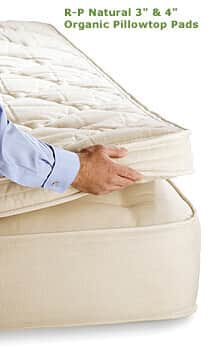
A three-inch latex pillowtop pad, for example, is a more substantial change than a thin cotton pad. The Royal-Pedic Natural Latex Single-Sided 3-inch Pillowtop Pad is described as a natural Dunlop latex layer encased in cotton and quilted with French lamb’s wool. Its construction illustrates how a topper may combine a resilient core with a softer, moisture-managing outer layer. Because the product is three inches thick, shoppers should consider not only its feel but also the added height it will bring to the bed and whether fitted sheets can accommodate the combined mattress-and-topper depth.
Latex also introduces practical questions. Is the pad intended to be flipped, or is it single-sided? Does it have a boxed edge or a more flexible outline? How is it secured? Is the cover removable? These are not minor matters. A layer that cannot be washed should be paired with a suitable protective strategy, and a dense topper may be awkward to rotate or handle. The most comfortable construction in a showroom or product description still has to work within the ordinary life of the bedroom.
Wool, down, and blended fills
Wool is prized in bedding for its ability to cushion while managing moisture and moderating temperature. In a topper or pad, it may create a softly resilient surface rather than a deeply sinking one. Its behavior depends on how much is used, how it is quilted, and what surrounds it. Some wool layers are intended primarily to add a breathable buffer; others provide more substantial loft. Because wool can compress gradually with use, a buyer should look for clear construction details and instructions for airing, rotating, or cleaning the item.
Down and other lofty fills offer a different kind of comfort. They can feel soft and yielding, with a gentle, pillow-like surface, though they may not provide the same stable, even cushioning as a denser pad. Fill amount, chamber construction, and quilting help determine whether the material stays distributed or migrates. Anyone who likes a plush hotel-bed impression may enjoy loftier bedding, while someone who wants a firm, consistent plane may prefer a more structured layer.
Blends are common because no single fiber has to perform every task. One layer might provide resilience, another softness, and the cover durability or breathability. A carefully described blend can be more informative than a grand claim about a single “miracle” material. Read for proportions and construction where available. If a listing describes the feel in lyrical terms but gives little account of what is inside, it is difficult to predict how the topper will behave after several months of use.
Thickness changes more than the silhouette
Thickness is one of the clearest indicators of how substantially a topper may alter the bed. A thin pad can smooth the surface and add a modest cushion. A thicker topper can change pressure distribution and the sensation of sinking or buoyancy more noticeably. But thickness alone does not determine firmness. A dense, supportive material may feel quite different from a lofty fill of the same depth, and a soft layer can compress quickly beneath heavier parts of the body.
A thicker topper also alters the geometry of the bed. The fitted sheet must stretch over the combined depth, including any mattress protector and pad beneath it. Deep-pocket sheets are not a universal solution: if the pocket is too deep for the total stack, the fabric can fit loosely; if it is too shallow, corners may pull free. Measuring the mattress and each layer before ordering is a small act of domestic arithmetic with a disproportionately large payoff.
The bed frame matters, too. A topper adds weight and may shift if the mattress cover is slick or if the layer has no attachment. A fitted skirt, elastic anchor bands, ties, or a textured underside can help, though no fastening system is equally suitable for every bed. If a pad is meant to sit directly on the mattress and be held by the protector and sheet, that arrangement should be understood before purchase. A luxurious surface is less persuasive after it has migrated several inches toward the foot of the bed.
Fit is a technical detail with a daily consequence
Start with the mattress size, then check its depth and shape. Standard dimensions are useful, but mattresses vary in height, and pillow-top designs may be thicker than their nominal size suggests. Some pads use deep fitted skirts; others rely on corner straps or elastic bands. A skirt must stretch far enough to go beneath the mattress without being so loose that the pad wanders. If the bed has an adjustable base, confirm that the layer is designed to move with it.
A protector and a topper can coexist, but their order and function should be clear. A protector is usually placed close to the mattress to shield it; a comfort layer sits above it, though particular products may specify another arrangement. A thin protector should not erase the feel of a topper, but a noisy, stiff, or poorly fitting one can influence the surface. The Vispring Lux Skirted Mattress Protector, for instance, is described as a quilted cotton-and-wool protective layer with an elasticated skirt. It is a useful example of a product whose primary role is preservation and fit, rather than adding several inches of cushioning.
Care, durability, and the fine print
A topper lives in close contact with the sleeper, so care is part of its performance. Look for explicit instructions on washing, drying, airing, spot cleaning, and exposure to sunlight or heat. A removable cover may simplify maintenance, but it does not mean the inner material is washable. Silk may need dry cleaning; latex may require protection from direct heat or sunlight; wool can have care constraints of its own. Treat the manufacturer’s instructions as part of the product’s design, not as an afterthought.
Protection can extend the useful life of a layer. A washable protector or pad can intercept perspiration and everyday spills before they reach a mattress. But stacking too many layers may alter temperature, add bulk, and complicate sheet fit. There is a point at which “more” ceases to mean “better,” especially when every layer is selected for a different promised benefit. A considered bed is not necessarily a heavily layered bed.
Durability is difficult to infer from material names alone. Fiber quality, density, construction, stitching, and frequency of use all matter. A topper that feels sumptuous on its first night may compress or settle differently over time. Look for a warranty that explains what is covered, and distinguish manufacturing defects from ordinary softening or compression. If a seller provides no meaningful information about care or construction, that absence should temper confidence in any promise of longevity.
A practical way to choose
Before comparing premium bed toppers, take stock of the bed as it is. Is the mattress supportive and in good condition? Is the problem a hard surface, a warm feel, a desire for protection, or a sheet that never stays on? These are different problems, and they lead to different layers. A protector addresses exposure; a cotton pad may provide light cushioning; a thicker latex topper may make a more pronounced change. A topper should be chosen to answer a specific question, not simply because the bedding vocabulary makes another layer sound indispensable.
- For light cushioning: Compare thin cotton or wool pads, paying attention to fill, quilting, and laundering.
- For a more noticeable surface change: Consider a thicker construction, such as latex, and account for its firmness, weight, and added bed height.
- For a lighter, smoother layer: Investigate silk or other fine fills, while checking temperature expectations and cleaning requirements.
- For mattress preservation: Prioritize a well-fitting protector, and do not mistake it for a deep comfort topper.
- For an existing support problem: Assess the mattress itself. A topper may soften the surface, but it cannot restore a worn or sagging core.
The luxury of getting the details right
Luxury in bedding is often treated as a matter of plushness, though plushness is only one possible preference. A refined sleep surface may instead be light, cool, resilient, easy to maintain, or almost imperceptibly improved. The best layer is not necessarily the thickest or most elaborate; it is the one whose materials and construction suit the mattress, the sleeper, and the routines of the household.
That judgment is made through details that seldom command attention at first: the way a skirt grips, whether a cover can be cleaned, how a fill breathes, how many inches a fitted sheet must stretch, and whether the added cushion preserves the mattress’s underlying support. These are ordinary questions, but they describe the real experience of a bed more faithfully than a promise of cloud-like comfort.
A topper is at its best when it makes the bed feel more considered without announcing itself. Cotton, silk, wool, latex, and blended fills each offer a particular combination of cushioning, temperature feel, moisture handling, and care. There is no universal winner among them. By identifying the desired change, checking thickness and fit, and reading the instructions as carefully as the material claims, a sleeper can choose a layer that improves the surface while leaving the bed’s essential support intact. In the quiet business of sleep, that is a small adjustment—and often exactly the right one.